Nyamot is raising a young child while trying to stay in school. Fatuma says arriving in Kenya changed her life because, for the first time, she had the opportunity to learn. Their stories reflect the reality facing thousands of refugee women and girls in Dadaab where safety is not only about crossing a border, but about living with dignity, continuing an education, and believing that tomorrow can be better.
How Dignity Kits are Helping Refugee Women and Girls rebuild their lives
This year marked the 75th anniversary of the 1951 Refugee Convention, the landmark promise that people forced to flee persecution, conflict and disaster have the right to seek safety. UNHCR’s theme for World Refugee Day 2026, observed on June 20 was ‘Until Everyone Is Safe’ which asks us to measure that promise honestly against today’s reality.
Turning that promise into reality requires more than emergency assistance. It means helping women and girls rebuild their lives every day. In Dadaab, that reality is complex as refugee families continue to face overlapping pressures such as cuts to humanitarian assistance, heightened risks for women and girls, climate-related shocks, and the daily strain of trying to build a future in prolonged displacement. Yet across the refugee camps, women and girls are also showing extraordinary resilience and with the right support, they are holding on to education, dignity and hope.
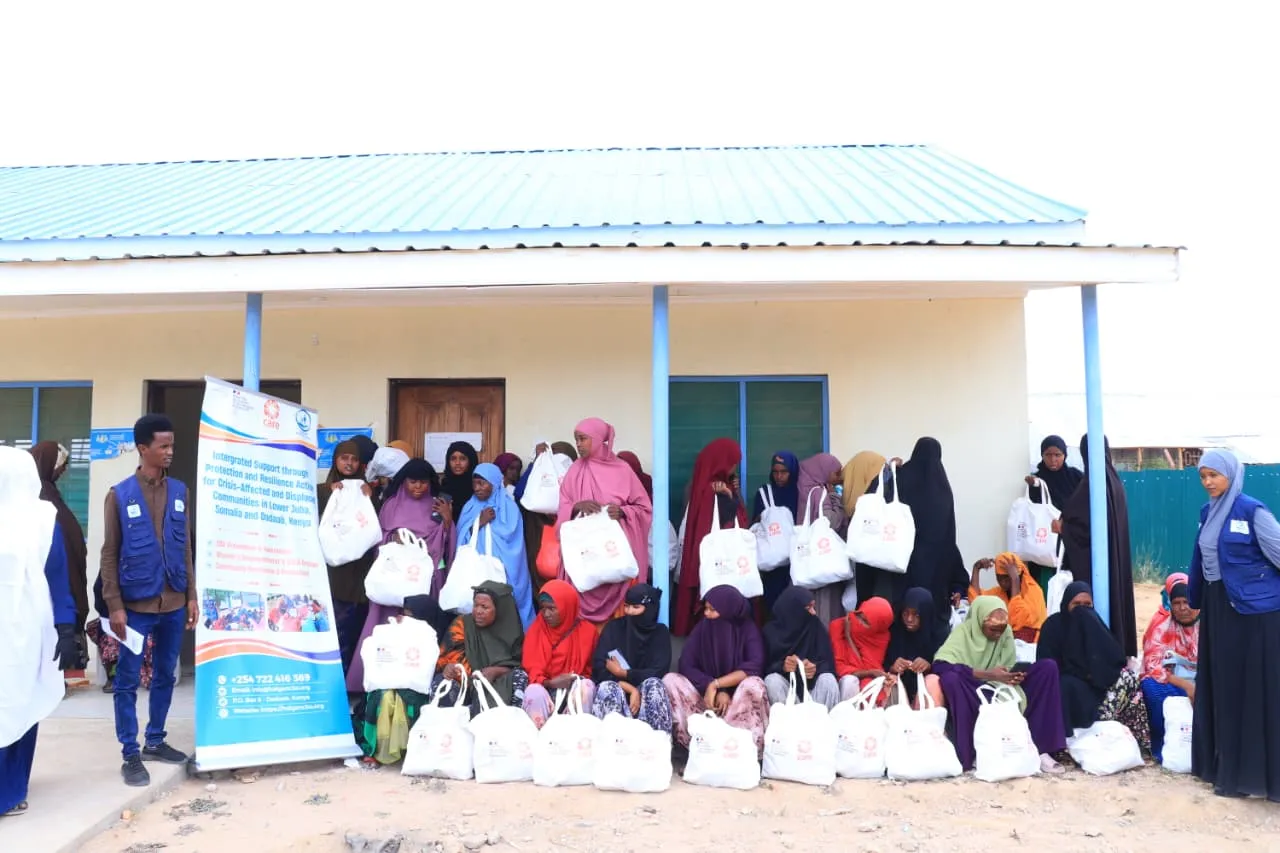
In Dadaab, CARE Kenya works alongside refugee and host communities, local organisations and government partners to ensure women and girls can access protection services, legal support, safe spaces, dignity kits and opportunities to rebuild their lives. This support is delivered through the CDCS Protection and Resilience Action Programme, funded by the Ministry of Foreign Affairs of Denmark and implemented together with the Refugee Consortium of Kenya (RCK) and Halgan.
Humanitarian needs remain significant, but so is the impact of targeted support.
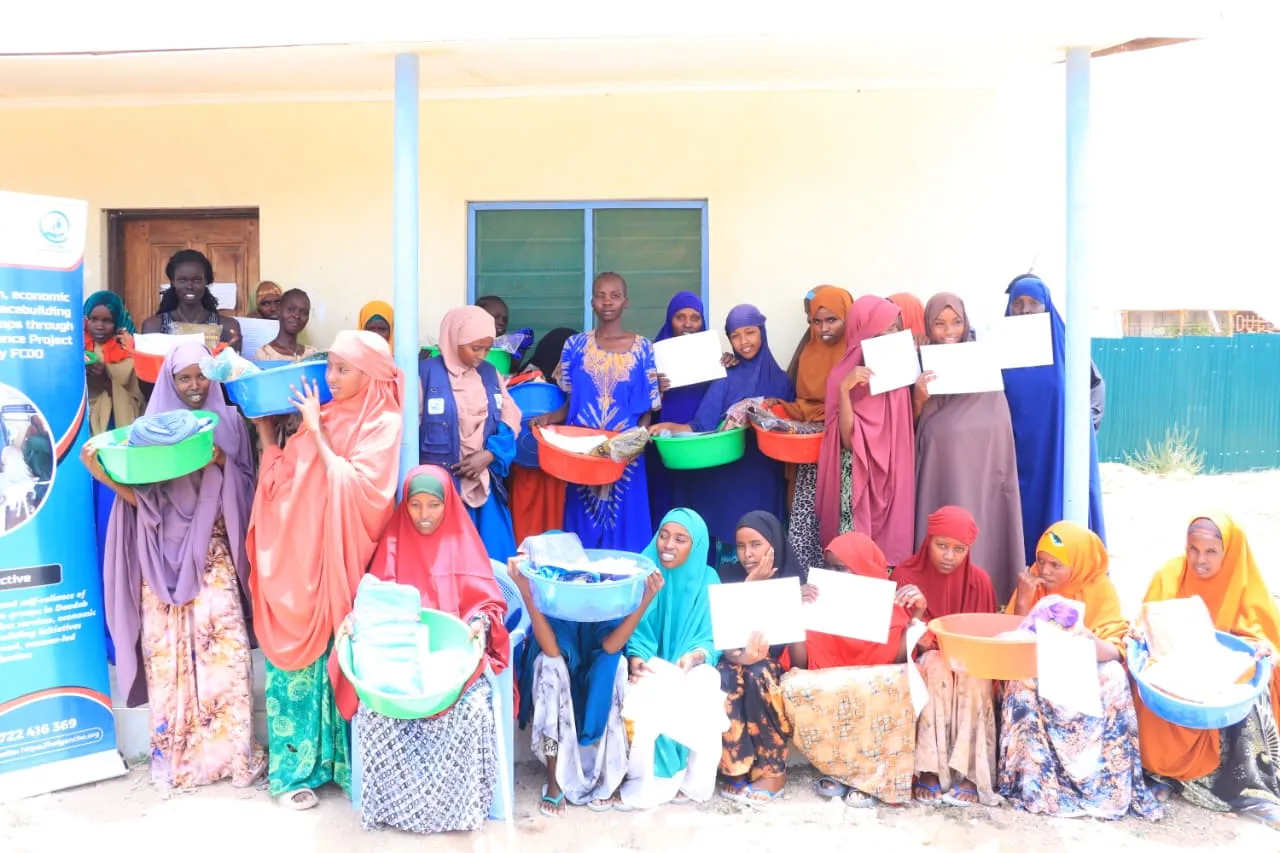
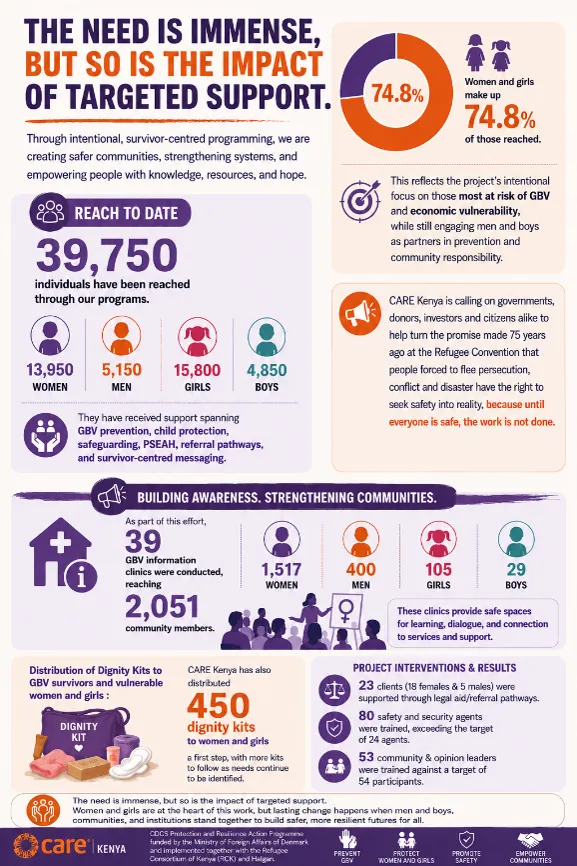
Humanitarian needs remain significant, but so is the impact of targeted support. To date, 39,750 refugees and host community members have been reached, including 13,950 women, 5,150 men, 15,800 girls, and 4,850 boys. They have received support spanning from GBV prevention, child protection, safeguarding, Protection from Sexual Exploitation, Abuse and Harassment, referral pathways, to survivor-centred messaging. Women and girls make up approximately 74.8% of those reached, reflecting the programme’s focus on women and girls, who face heightened risks of violence and economic barriers, while engaging men and boys as partners in prevention and positive community action. As part of this effort, 39 GBV information clinics were conducted, reaching 2,051 community members, among them 1,517 women, 400 men, 105 girls, and 29 boys. There has also been distribution of 450 dignity kits to women and girls a first step, with more kits to follow as needs continue to be identified.
Data as of June 2026
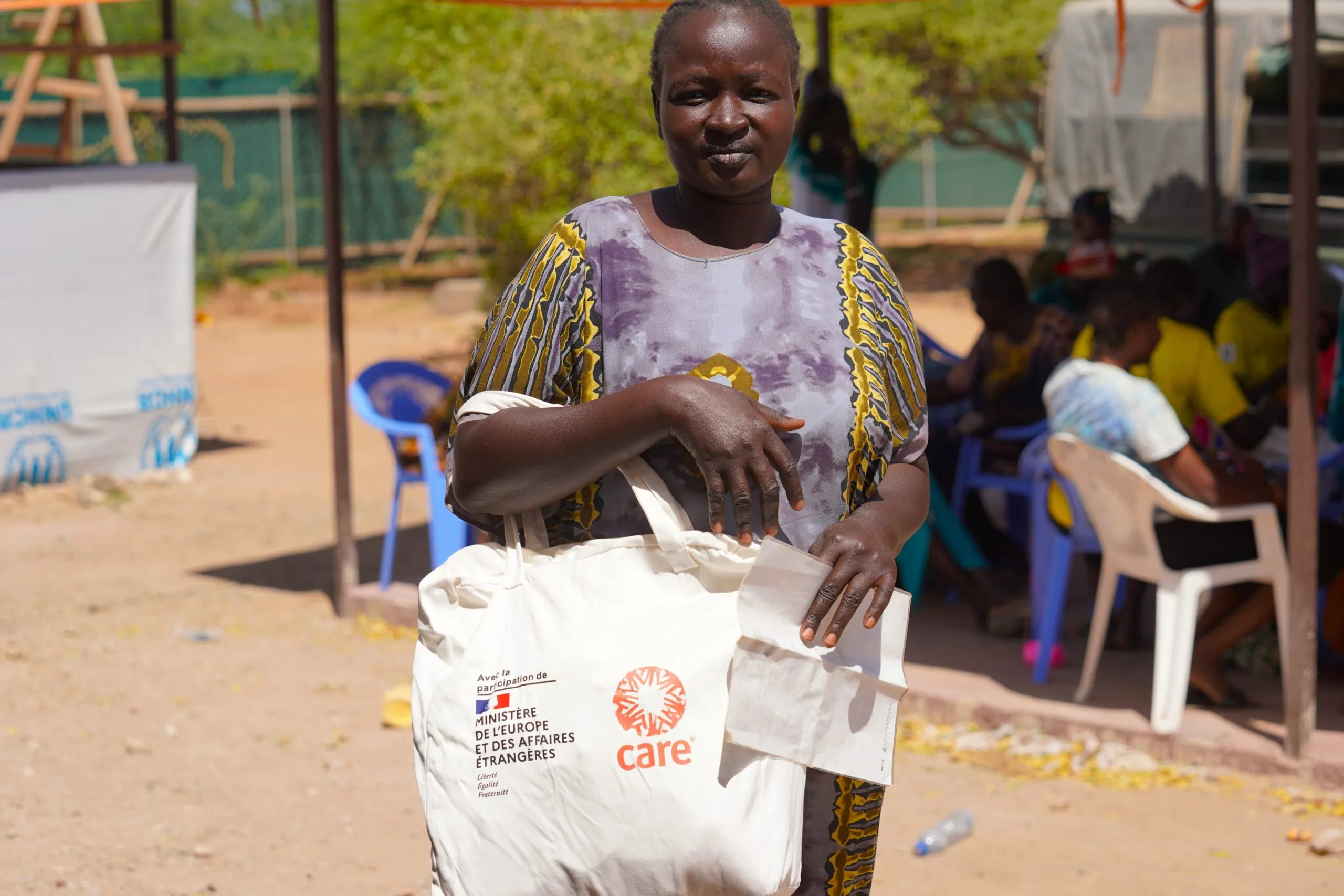
With all these statistics in play, one of the simplest yet most meaningful forms of support has been the distribution of dignity kits containing essential hygiene supplies that help women and girls manage menstruation safely and with confidence.
For Fatuma Ali Abdi, one of the girls, who was reached through this support, assistance came at a critical time. “The dignity kit was very helpful because it came at the moment we needed it most,” she says.
But what Fatuma speaks about is larger than the kit itself. It is about what timely support makes possible for a girl trying to continue her life with dignity. “As a girl, being here has changed my life because it gave me the chance to learn,” she says as a reminder that for many refugee girls, education is not simply a service but a form of protection and a chance to imagine a future beyond survival. Fatuma’s story is a reminder that refugee girls are not defined only by what they have fled but their aspirations, their resilience and their determination to keep learning when the odds are stacked against them. For Fatuma, education is not just a personal milestone but proof that with the right support, a girl’s future can still open up, even after displacement.
Same story from Nyamot Samueno, a young South Sudanese refugee, who knows how fragile that future can feel. She came with her stepmother and still does not know where her biological parents are. She is a single mother trying to continue her education while caring for her child and navigating displacement. Support such as dignity items has helped ease some of the pressure she faces as she tries to hold on to both school and motherhood at once.
Nyamot knows what it means to carry loss, uncertainty and responsibility at the same time. She knows what it means to try to keep learning when life is already demanding so much. As she talks about the kits she says, “Being here has changed my life. Back home, girls did not have the same opportunity to learn. Here, I can imagine a different future.”
She speaks of tomorrow and her message to other refugee girls and women carries both pain and hope, “Never give up. There is a better future, a better tomorrow for us.”
These stories underscore a simple truth that for refugee women and girls, dignity is not a side issue but it is central to whether they can stay in school, care for their families, recover from violence and continue moving forward.
Stories like Nyamot’s also reflect a broader shift taking place across Kenya’s refugee response. CARE Kenya’s work in Dadaab also sits within a bigger national shift. Through the Government of Kenya’s Shirika Plan, which was launched in 2024, Kenya has made a bold and globally significant commitment to move away from refugee containment and toward refugee inclusion. Under this vision, Dadaab is no longer seen only as a camp, but as a place where refugees and host communities can live, work and build together.
That vision matters because protection alone is not enough. Women and girls need safety and dignity, but they also need opportunities, services and systems that allow them to build stable futures. Our work in Dadaab is helping demonstrate what that can look like in practice, a model where protection, inclusion and self-reliance are pursued together, not separately.
For women like Fatuma and Nyamot, dignity is more than access to essential supplies. It is the freedom to stay in school, care for their families, recover from hardship and continue dreaming about the future. Their stories remind us that the promise made 75 years ago through the Refugee Convention remains unfinished, but every act of support brings that promise closer to reality.
CARE Kenya is calling on governments, donors, investors and citizens alike to help turn the promise made 75 years ago at the Refugee Convention that people forced to flee persecution, conflict and disaster have the right to seek safety into reality, because until everyone is safe, the work is not done.